

Parental Recovery: Nervous System Regulation After Violent Outbursts
EMERGENCY LANDINGS: TAKING STOCK AFTER THE STORM
There are moments in family life that simply don't make it into the glossy parenting books. You know the ones, the books that promise that a 'time-in' or a specific tone of voice will magically diffuse a situation.
But then there are the other moments. The moments where theoretical frameworks, carefully rehearsed responses, and strategies practiced in the sunnier seasons of life recede into the background. What remains is the primal, exhausting, and often lonely work of keeping everyone safe.
If you know, you know.
This isn't a blog about the 'during' moments. During is survival; it’s pure adrenaline and autonomic reflex. This is about the strange, suspended territory that follows: the emergency landing.
WHEN EVERYTHING ESCALATES
Working as both a psychological therapist and a physiotherapist, I spend a lot of time looking at how the unspoken lived experience of trauma sits in the body. When I work with parents managing violence in the home, a common thread emerges: we talk endlessly about de-escalation and being the calm co-regulation mirror for the child. These things matter, but sometimes the storm arrives in full force regardless of your breathing technique or anything else you do.
The reasons a child reaches this point are rarely simple. As a clinician and very often the parents, we can see the why everywhere. Empathy is in abundance:
The Weight of Trauma or Disruption: Abuse, adoption, foster care, divorce or early medical trauma.
The Neurological Imprint: The lasting impact of experiences a child cannot yet name.
Physiological Hijacking: Conditions like encephalitis or a post-ictal state after an epileptic seizure and frustrations of growing up can lead to aggression, but have biological understanding.
Neurodiversity vs. Environment: A nervous system designed for a different world colliding with an environment it wasn't built to hold.
Self-Medication: Poor choices made to manage unbearable internal states from any of the above through substances or risk-taking.
None of this makes violence acceptable, but all of it makes it comprehensible to the parent or carer who loves and supports their child.
You can have a 100% rate of getting through and yet can still fear for your life in the middle of it. Both things can be true at once. This blog is also not to say that sometimes the emergency services are needed, and I understand that this can be a hard decision for parents to call these when it is between them and their child.
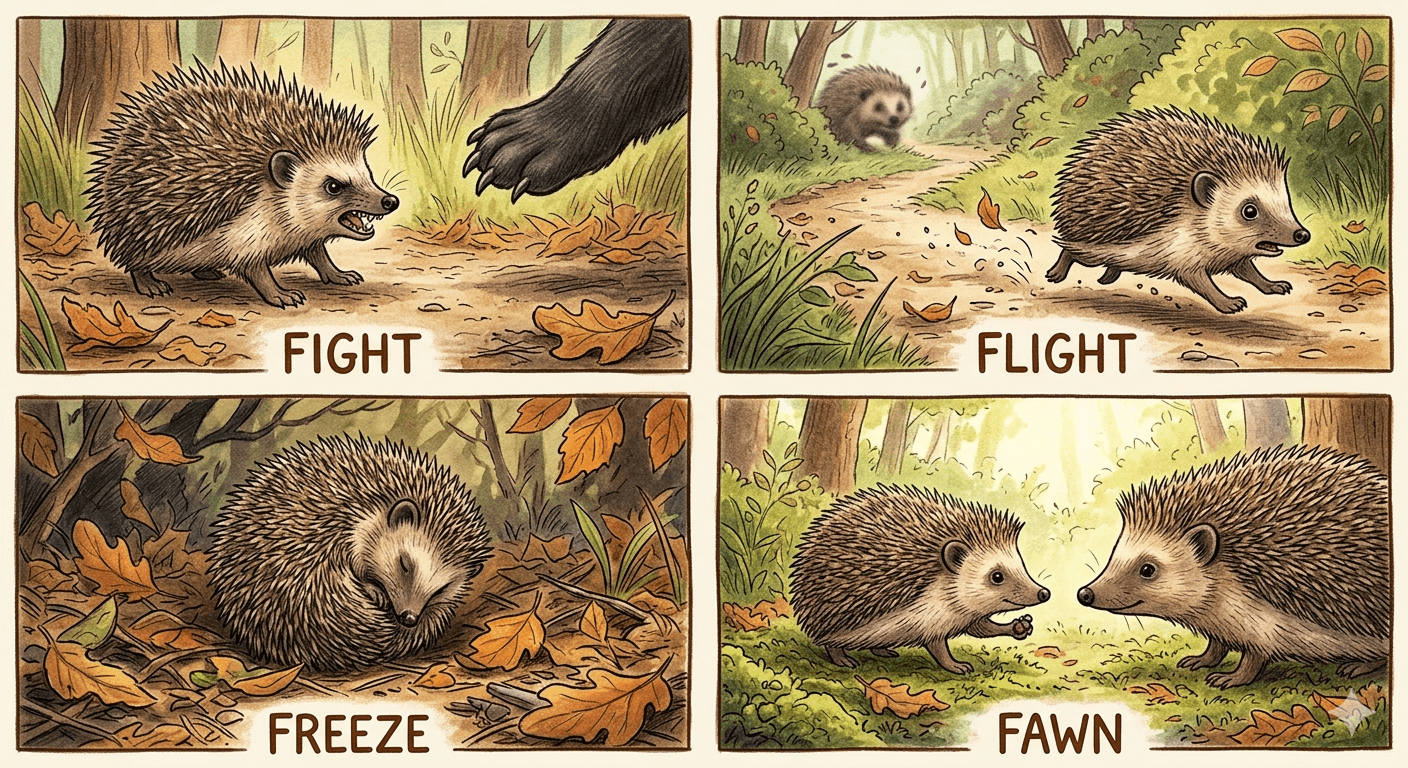
THE ANATOMY OF THE STRESS RESPONSE
In my practice, I’ve watched parents move through every variation of the stress response: fight, flight, freeze, and fawn. I’ve seen parents go silent, go physical, go appeasing, or simply seem to go absent. I’ve heard them talk about things they wish they had done better later. I’ve seen them hold on by a thread and somehow not let go. What I have never seen is anyone doing it perfectly. There is no perfect when the threat is real and your nervous system is doing exactly what it was evolved to do: survive and protect.
THE EMERGENCY LANDING
Then, it stops...or it pauses. The child exhausts themselves, and the air in the room shifts. You’re still there. Others are still there. The immediate danger has passed. This is the emergency landing. It’s that eerie, uncanny moment where the plane has touched down, but you aren't sure the runway is clear. You don’t know whether to breathe out or brace. Is this a lull? Is the stillness real, or is it a strategy?
Your body is still scanning for threats, even as you move through the motions of making a cup of tea or checking the locks. This stage is often left out of the literature, yet it’s where the most profound psychological maintenance needs to happen.
A STRATEGY FOR THE RUNWAY
Through clinical work and my own lived experience, I’ve found that having a loose framework, orientations rather than rigid protocols, can change the trajectory of what comes next.
1. Breathe First
This sounds cliché, but it is biological. Your body is still flooded with cortisol and adrenaline. Your breath is likely shallow and high in the chest.
The Hack: Slow, extended exhalations. This stimulates the vagus nerve and activates the parasympathetic nervous system. It’s a physical signal to your brain that the 'lion' has left the room. You don’t need to be 'serene', you just need to create the conditions where you can think again.
2. Know Your Safe Call
Violence in the home creates a unique, suffocating isolation. Shame drives families inward. At the landing, you need to know, in advance, who you can contact.
The Rule: It must be someone who will answer and not make it worse. Someone who understands that comprehensible doesn't mean okay.
3. Maintain Connection Without Shame - Including Your Own
If there are other children or a partner present, the temptation is to either collapse or perform a mask of composure.
The Middle Path: Acknowledge what happened without dramatising it. In Non-Violent Resistance (NVR), we say 'strike when the iron is cold.' This is not the time for the big talk, the consequences, or the boundary-setting - that will come. Here, you are simply landing. Checking everyone is safe, including you.
THE LANGUAGE OF PRESENCE
The work of Haim Omer is vital here. He speaks of parental presence as the foundation of the parental role. In the emergency landing, the temptation is to be anywhere but here, including within yourself. You could be rehearsing what you should have done or catastrophising about tomorrow.
Omer invites a return to the relational field. Your presence communicates the narrative of the home. Does your presence say "You caused this chaos", 'You should have done more' or does it say "We survived', or at a push, 'We survived this storm together"?
Presence isn't a performance of calm; it’s the willingness to stay in the room without abandoning yourself or the child. It’s about structural integrity. A harbour holds ships in storms because it is stable, but that stability requires constant maintenance and inspection before and after every heavy swell. It is not denying the impact that is has on you as a human being. It is honouring you, and all the humans in the situation as well.
NOTICE THE PATTERN
If you are the safe harbour for a child whose internal weather is severe, you are doing extraordinary structural work, but structures under repeated load need repair.
Take a moment to notice your own landing patterns:
Do you hold your breath for hours after the event?
Do you isolate yourself out of shame?
Do you jump straight into fixing before your own nervous system has regulated?
Naming these patterns is the first step toward changing the dynamic.
You have a 100% rate of getting through. Every single time so far. Hold onto that truth, even when it doesn't feel like enough.
Land. Breathe. Find your ground. The rest can wait.

YOU MIGHT ALSO LIKE

Connections Training & Therapy
Unit 9, Hunters Hill Farm, Crakehall, Bedale, DL8 1LA
Space available in Catterick Garrison DL9 3AY and DL9 4HP for Armed Forces.
About Verity Green
MBACP (Acc) and HCPC Registered. Covering Catterick Garrison, Richmond, Bedale, RAF Leeming, North Yorkshire and Online. Therapy and training with trauma, long term conditions and disability, adoption, care leavers, managing high conflict environments in the home, recovering from high control, and managing change from intense environments (such as sport, Armed Forces Community).



Updates in your Inbox!

Free Signup
You can Unsubscribe
Information is NOT sold
Approximately once a month
© 2025. All Rights Reserved