

The Continuous Battle Not Won: The System Weary Parent
PARENTING FROM THE EDGE OF BURNOUT
When your child is in crisis, you try to control everything to keep them safe, but the harder you pull, the more exhausted you get. You’re trapped in circles out of your direct control, worrying about things you can’t directly change.
WHEN EVERYONE HAS A 'TOOL' AND YOU JUST WANT TO BE 'MUM' (OR 'DAD')
In my practice and my own home, where I parent two children with SEN, I see the picture on paper rarely captures the lived reality. Navigating the system has a particular, exhausting texture. There are the EHCP (Education, Health and Care Plan) processes, the school reviews, and the letters that demand responses on timescales that assume you have no other life.
When I work with families, I hear a version of the same exhaustion: it isn't just from doing, but from the relentlessness of having to know. Having to be a researcher, a record-keeper, and a translator between what the system asks and what your child needs. I highlighted in my last post that a significant recent report raised the concept of Systems Generated Trauma - the way disabled children and their families are traumatised not by their condition, but by dysfunctional public services when they reach out for support. Most of the energy goes into things they cannot control.
MAPPING THE CHAOS: CIRCLE OF CONTROL
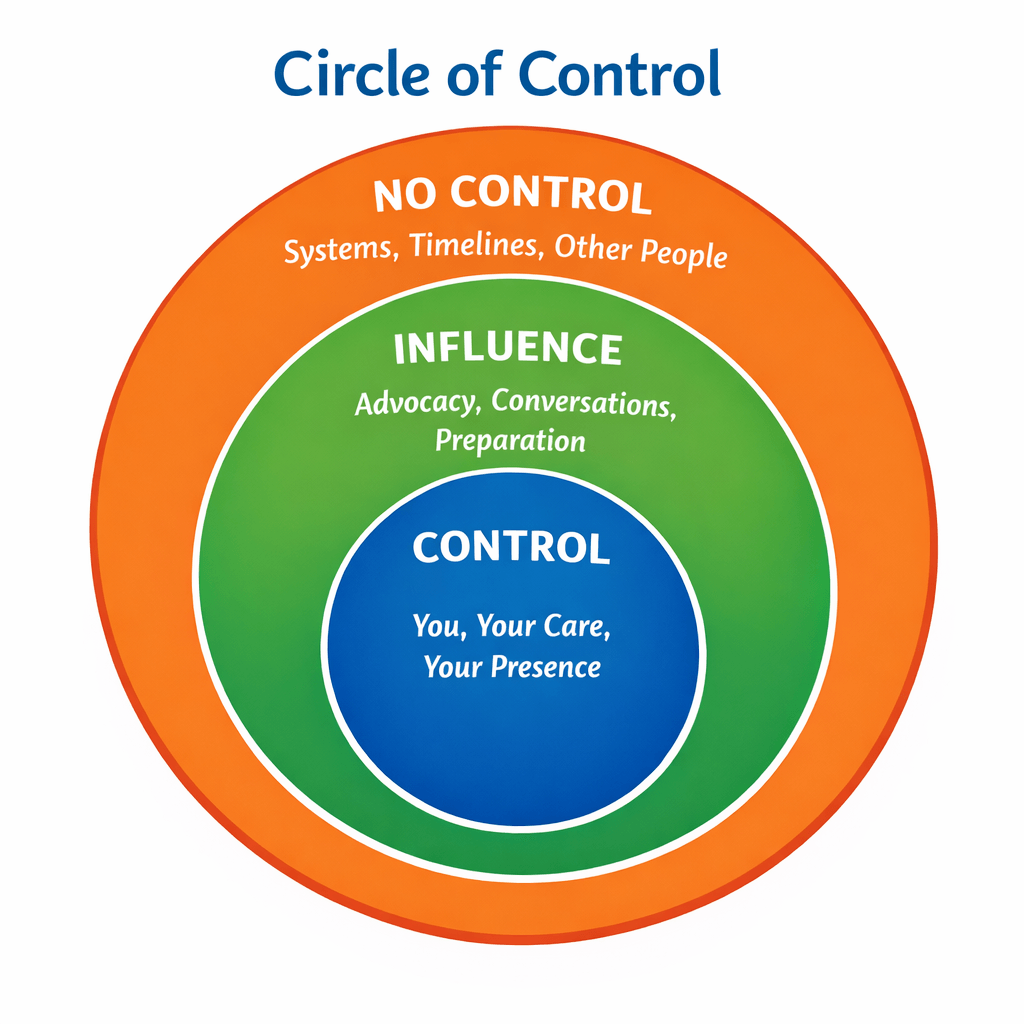
1. The Outer Ring: No Control
In the context of disability or SEN, this ring is often very full. Naming this honestly is not defeat; it can help understand where you put your energy and your emotions. Examples include:
The System: How quickly services respond or the length of waiting lists.
The Environment: How other children respond to 'difference' at school.
The Timeline: The organic pace of your child’s development.
2. The Middle Ring: Influence
These are things you can shift, even if you cannot determine the final outcome. Examples include:
Advocacy: How you frame and evidence an EHCP request.
Relationships: The quality of communication and the rapport built with school staff.
Preparation: Organising for appointments so limited time is used well.
3. The Centre: Direct Control
This is the most important area, and often the first to be neglected. This includes:
The Home Rhythm: Creating predictability and a 'safe harbour' environment.
The Repair: How you reconnect with your child after a difficult, dysregulated moment.
Your Regulation: Whether you are getting any rest, support, or time that is purely yours. This is probably the most forgotten in the generous parenting I see.
“I wish I could wake up one day and not be dizzy.”
Those were the words I said to my mum as a young girl. She remembers them not because they were dramatic - as a child they were matter-of-fact, but because of what came after them: silence. This was not the silence of indifference, but of a parent who loved me and had no power to fix this problem. She walked beside me, often literally, and I know now that her presence was everything. But the one thing she wanted to do, she could not: she couldn’t take the dizziness away. She was also faced with the challenges of another parent away from home, and juggling her work with me taking a lot of time absent from school. My Mum would be worried about the unknown diagnosis, the cause of the condition and the unknown future for me.
I don’t share this to frame my childhood as a tragedy, it wasn't, but because it is the ground from which I now work as both a psychological therapist, a physiotherapist and a parent myself. When I sit with parents navigating the complex world of SEN or disability, I carry that memory of my mother: present, steady, and quietly unable to do the the things she most wanted to do for me.
PRESENCE IS NOT PASSIVE
I want to be careful here: the Circle of Control is not a saying that you have passive input across the board. My mother was not passive when she walked beside me. She attended every appointment and persisted when doctors did not know what was going on. She did all of this without being able to change the fundamental fact of my condition. She has been with me and my confusion, exploring what is going on for me through adulthood.
There is a difference between expending energy where it cannot move anything and choosing where to direct effort wisely. When I was navigating my unknown diagnoses as a child and even into adulthood, the thing that mattered most was not that my mother could stop it. It was that she was there. The steadiness of her presence was its own kind of stabilisation for my nervous system.
What I wish most for my Mum was that she looked after herself. I never blamed her for how I was, and I would not want her blaming herself.
A PERMISSION STRUCTURE
Nothing here is intended to suggest you are doing it wrong. If you are parenting a child with complex needs, you are likely doing more than is ever acknowledged.
What I hope this framework offers is permission. Permission to stop spending energy in places where it cannot land.
Permission to tend to your own wellbeing and the relationship.
Permission to just be a parent for an afternoon, without it being a 'therapeutic activity.'
The dizziness did not go away, and my mother could not make it. But because she walked beside me, I learned to navigate a body I hadn't chosen. That navigation required both of us, and it started with her just being there.
YOU MIGHT ALSO LIKE
Connections Training & Therapy
Unit 9, Hunters Hill Farm, Crakehall, Bedale, DL8 1LA
Space available in Catterick Garrison DL9 3AY and DL9 4HP for Armed Forces.
About Verity Green
MBACP (Acc) and HCPC Registered. Covering Catterick Garrison, Richmond, Bedale, RAF Leeming, North Yorkshire and Online. Therapy and training with trauma, long term conditions and disability, adoption, care leavers, managing high conflict environments in the home, recovering from high control, and managing change from intense environments (such as sport, Armed Forces Community).



Updates in your Inbox!

Free Signup
You can Unsubscribe
Information is NOT sold
Approximately once a month
© 2025. All Rights Reserved