
How We Lose Social Cues Working Online and What the Still Face Experiment Can Teach Us
A sea of poker faces on video call didn’t just feel uncomfortable. For those of us who grew up reading the world through faces, it was a quiet developmental catastrophe, and we didn’t have words for it until now.
When the world moved online in March 2020, something strange happened in meeting rooms that nobody had a name for. Cameras turned off. Faces froze. Voices floated in from black rectangles. Millions of people found themselves inexplicably anxious, withdrawn, exhausted, not from the work itself, but from the act of being together in a room that wasn’t a room. I was one of them. And I couldn’t explain it, not for a long time.
I am deaf. I grew up reading faces the way other people read text, rapidly, continuously, as my primary channel of understanding. Lip patterns, micro-expressions, the tilt of an eyebrow, the warmth or coolness around someone’s eyes. These were not supplementary cues for me, they were the signal itself, and in one sudden pivot that signal went dark.
The experiment:
In 1975, developmental psychologist Edward Tronick designed a now-famous study. A mother engages warmly with her infant, smiling, responding, alive with expression. Then, on instruction, she goes still. Blank face. No response. Total expressional withdrawal. Within seconds, the infant begins to work harder: reaching, pointing, vocalising, trying to re-engage. Within minutes, if the stillness continues, the baby turns away, folds inward, and shows signs of acute distress. When the mother re-engages, it takes time for the child to recover trust. The damage, however brief, leaves a trace. This is the Still Face Experiment.
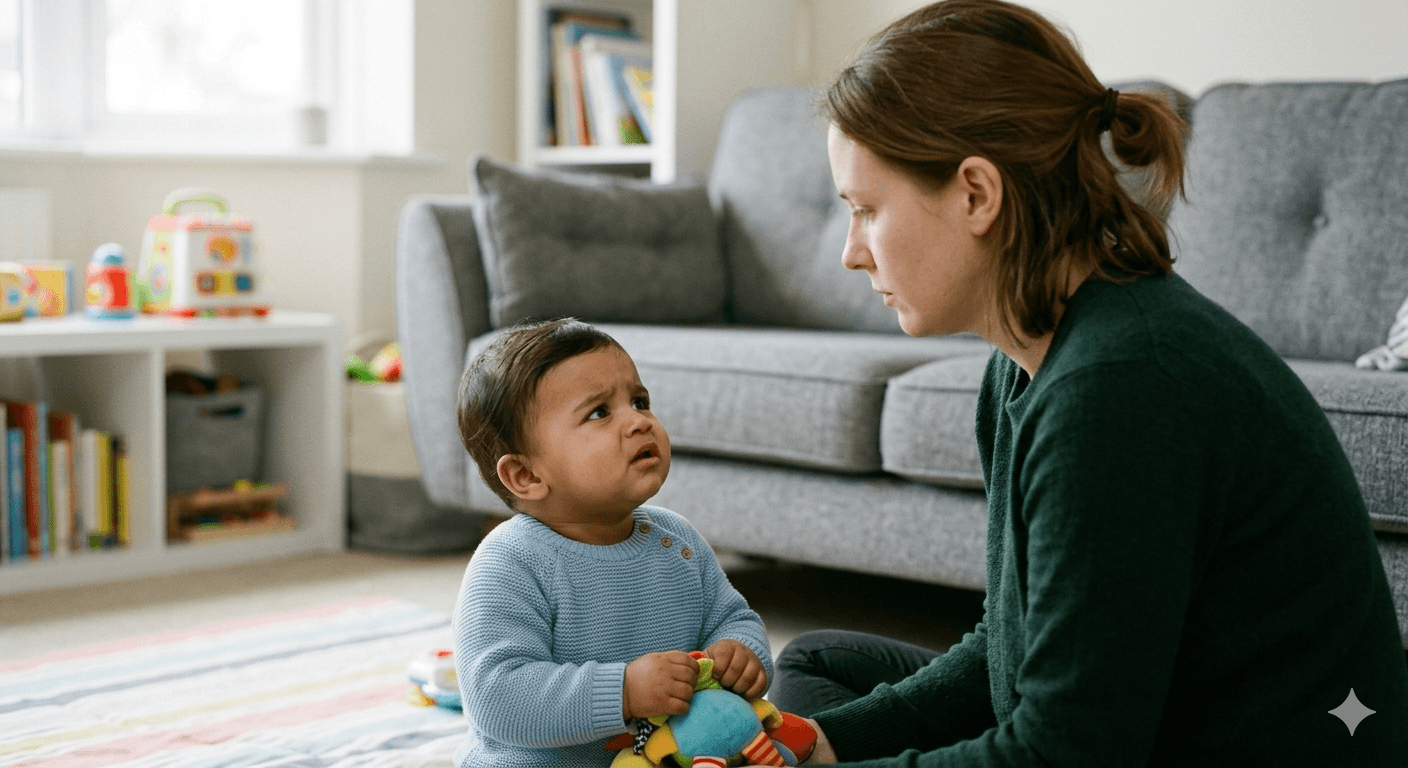
I was reminded of this study partway through the pandemic, and I felt genuine horror settle in my chest as I recognised myself in that infant. Here I was, a grown adult, a therapist and researcher, someone who had spent a career studying communication, compassion and human connection, reacting to video calls with the same primitive distress as a baby whose mother had gone blank. Retreating. Switching my own camera off. Disengaging from the very interactions I needed most.
The cameras didn’t just remove faces. For those of us who had always relied on them, they removed the very architecture through which we had learnt to belong.
A lifetime of face-reading, suddenly redundant:
Deaf people were not strangers to video technology. Before the pandemic we used video relay services, video messaging systems like glide and live video calls. The deaf community had long understood the value of visual communication channels. The pandemic didn’t simply expand video use; it transformed its social grammar entirely.
Before 2020, video calls within the deaf community were expressive, face-forward, gestural, alive. People leaned in. They used their whole faces. Communication was embodied. I had training on how to adapt the language for being on screen: we are 3D people, not flat 2D people, therefore the 3D language of sign language can be modified to be more effective on the flat screen.
The mass adoption of workplace video culture brought something entirely different: a set of norms imported from audio-call culture, where blankness, stillness, and minimal expression were treated as professional neutrality.
The result, for those of us dependent on faces, was a cruelly specific kind of isolation. Not the isolation of silence, we were used to navigating that, but the isolation of being surrounded by present-but-absent faces. Faces that registered nothing. Responded to nothing. Stared without seeing. Tronick’s still face, multiplied by twenty-four tiles on a screen.
The experiment nobody designed:
What makes this more than a personal story is the scale at which it happened. The pandemic did not run a still face experiment on infants in a controlled laboratory. It ran one, accidentally, without consent, without awareness, on hundreds of millions of adults, across every industry, every culture, every age group.
The effects are everywhere, even if we haven’t named them correctly. The peculiar exhaustion of video calls that have no visible emotional response. The unease of presenting to a grid of black squares. The way people became simultaneously more isolated and more surveilled, watched, but not seen. The strange grief of not being able to tell whether your words were landing.
For those who built their social architecture on face-reading: deaf people, autistic people, those with social anxiety, those who grew up in emotionally unpredictable homes and learnt to watch faces for survival: it was something closer to a rupture. We are more connected than ever, and yet more lonely than ever too.
The infant in Tronick’s experiment recovers when the mother re-engages. But what happens when the still face lasts not two minutes, but years? What happens when an entire generation of workers, students, and children learns that faces do not respond, that the social contract of mutual recognition has been suspended indefinitely?
The day I decided to smile back:
There was a training session long after the pandemic finished, run by an excellent trainer. I decided, almost as an experiment, to try something different. I turned my camera on. I smiled when the trainer said something interesting. I nodded when I followed a point. I let my face do what it had always done naturally, before video culture had flattened everything into neutrality.
The trainer began to address me directly., consistently, warmly. As though I were the most engaged person in the room; which, by the metrics of visible response, I suppose I was.
For someone who grew up deaf, sitting at the front of every classroom so that I could attempt to follow the class, quietly daydreaming through lessons because nobody expected visible engagement and teachers were too uncertain to call on me, this was a revelation of a different kind. I had accidentally discovered that expressiveness in a still-face world was not vulnerability. It was power.
What this asks of us:
The still face experiment teaches us something fundamental: responsiveness is not merely pleasant. It is a biological necessity. From our earliest days, our nervous systems are calibrated against the faces of others. We regulate, co-regulate, orient, and belong through the continuous exchange of visible emotional signal.
When that exchange is stripped away, whether from a mother’s deliberate withdrawal in a laboratory, or a culture’s inadvertent adoption of expressional minimalism on video, the cost is real, measurable, and borne most heavily by those who already relied on faces most.
There are practical implications here, for organisations rethinking hybrid work, for educators designing online learning, for therapists and practitioners working with clients via screen. There is also something more fundamental being asked: that we resist the drift toward blankness. That we consider expressiveness not as performance, but as a form of care.
Smiling and nodding on a video call is not naive optimism. It is, in the most precise neurological sense, the opposite of withdrawing. It is the act of staying present, of refusing, in the face of a culture of poker faces, to run the experiment one more time.
YOU MIGHT ALSO LIKE

Connections Training & Therapy
Unit 9, Hunters Hill Farm, Crakehall, Bedale, DL8 1LA
Space available in Catterick Garrison DL9 3AY and DL9 4HP for Armed Forces.
About Verity Green
MBACP (Acc) and HCPC Registered. Covering Catterick Garrison, Richmond, Bedale, RAF Leeming, North Yorkshire and Online. Therapy and training with trauma, long term conditions and disability, adoption, care leavers, managing high conflict environments in the home, recovering from high control, and managing change from intense environments (such as sport, Armed Forces Community).



Updates in your Inbox!

Free Signup
You can Unsubscribe
Information is NOT sold
Approximately once a month
© 2025. All Rights Reserved